A practical guide to the few hours after a Colombian vote: how to read them, and what to set up before they arrive.
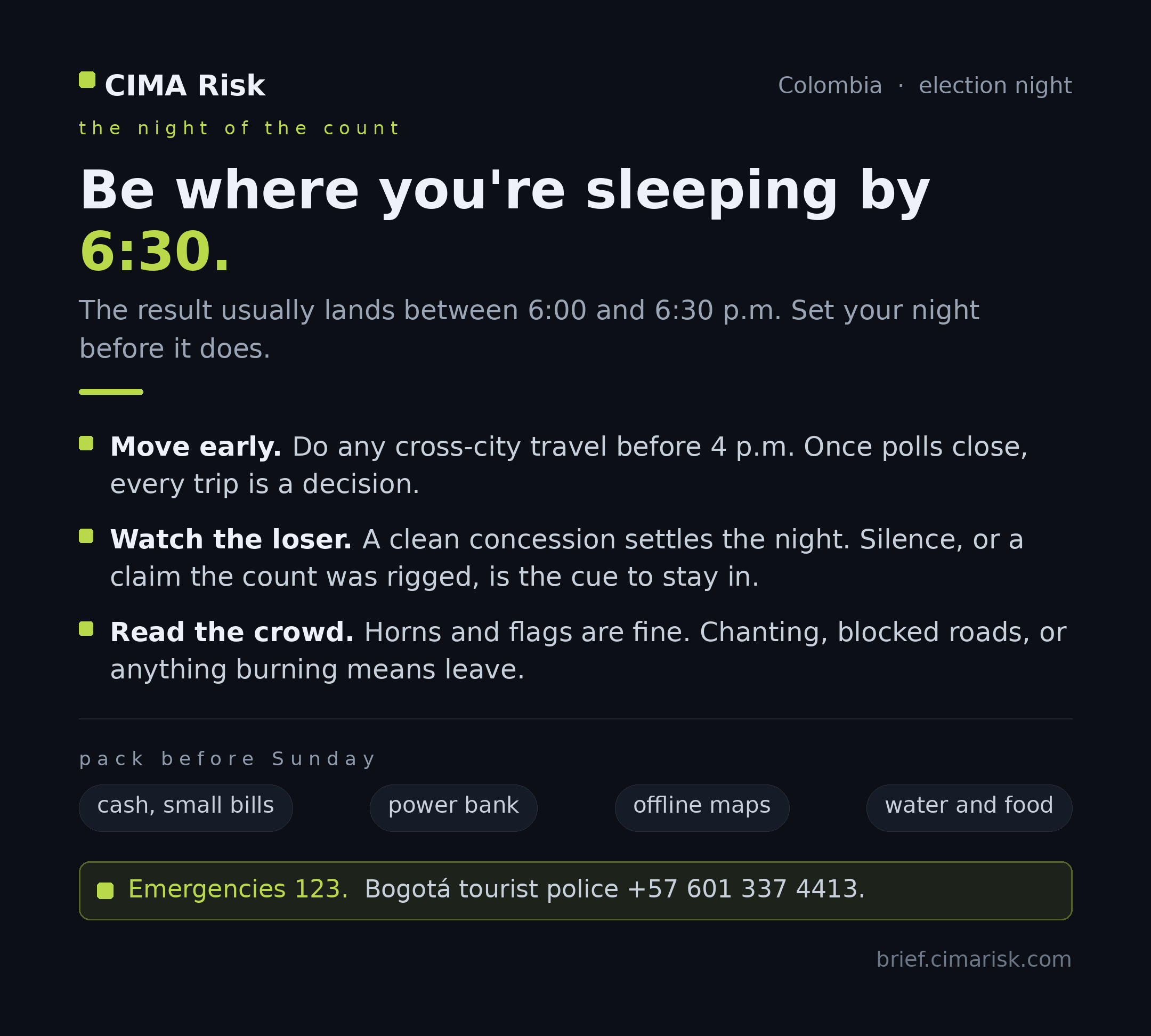
On Sunday, voting stops at four in the afternoon and the whole country settles in to watch the same number climb. By about half past six, it knows the answer. The official tally can take days, but the losing campaign reads the trend on its own screens by dinner, and so can you. Those ninety minutes between the close of polls and the obvious result are the part of the evening that matters, and most visitors brace for the wrong day and miss them.
We wrote last week about why the count is where Colombian election risk actually lives. This is the practical half: reading that night as it unfolds, and setting yourself up before it does.
The shift to watch is in the policing. Election day is the most locked-down day of Colombia's year, with a hundred thousand-plus officers on the street, aircraft overhead, and alcohol sales banned through the weekend. All of it is built for the vote, and none of it outlasts the vote by much. Once the result lands, the deployment thins, the bars reopen, and the plazas fill with people who feel strongly about how it went. That loosening, an hour or two after the number becomes obvious, is where the evening gets its edge.
All night you are answering one question: is this still a celebration, or is it turning into a contest. Four signals call it sooner than the vote totals do.
Concession, or the silence where it should be. A clean congratulation from the loser ends the night better than any percentage; a refusal to accept the count, or nothing at all, is what to weigh.
The words in the air. Fraud, a stolen vote, calls to gather and "defend" the result. Track verified campaign and authority accounts for those, not the loudest message forwarded to your phone, which is reliably wrong and reliably sure of itself.
The crowd's texture. Horns, flags, and caravans are a party. Chanting fixed to one spot, blocked intersections, and anything burning are not, and you can hear the difference from a hotel window.
The institutions. Riot police repositioning, or TransMilenio shutting stations, is the early warning. A closed station knows before the news does.
Most of the night, though, is won on Saturday, by making Sunday evening boring enough that you never need to step out. Small bills, because the night you need a card to work is the night the network is slammed. A charged phone, a power bank, offline maps. Your address in Spanish for a driver who is as turned around as you are. The emergency line, 123, already in your phone. Food and water so you can skip the supply run, transport arranged ahead, and one local contact who actually picks up.
From there the evening mostly minds itself. Cross the city before four, while it's easy; after the polls close, every trip is a choice you make on purpose. Be where you're sleeping by half past six. A clean concession keeps things at the level of a loud party, so skip the plazas and have the quiet night you packed for. A disputed or silent result is the cue to settle in, off the main avenues and away from the windows that face them.
The move that catches people is the airport. The road to El Dorado is Calle 26, and Calle 26 runs straight through the city's most reliable flashpoint, the junction at the Universidad Nacional. A Sunday-night flight looks fine when you book it on Friday and feels like a different decision at nine that evening. Give it a wide buffer, go before the polls close, or move it off the result window. Either way, check the route the morning of, because the city will not care about your itinerary.
Caught inside a crowd, the rules are dull and they hold. Don't film, don't argue, don't take a side out loud. Go with the flow, work your way to the edge and out, toward anywhere with a door and a person behind a desk, a mall or a hotel lobby. Avoid the packed TransMilenio platform, where a crush is its own hazard. Threatened, call 123 and get inside.
And if Sunday passes without trouble, which it may well, resist calling it done. Give it one more day. The alcohol ban lifts around midday Monday and the driving restriction comes back, so plan any ground move accordingly. A contested result doesn't reset overnight, however calm the morning looks.
None of this is a forecast. The date was set weeks ago, the result will be in by dinner, and the rough shape of the night is visible ahead of time. That is the whole advantage: the hours that carry risk are the ones you can see coming. By the time the crowd is your source of information, you are reading it from the inside. Decide while the streets are still quiet, and Sunday stays the boring evening you planned.
Calling the winner is someone else's job. Ours is the night it's decided: where risk gathers, when, and how to get your people through it. That's the read we publish every week on the CIMA Risk Brief.