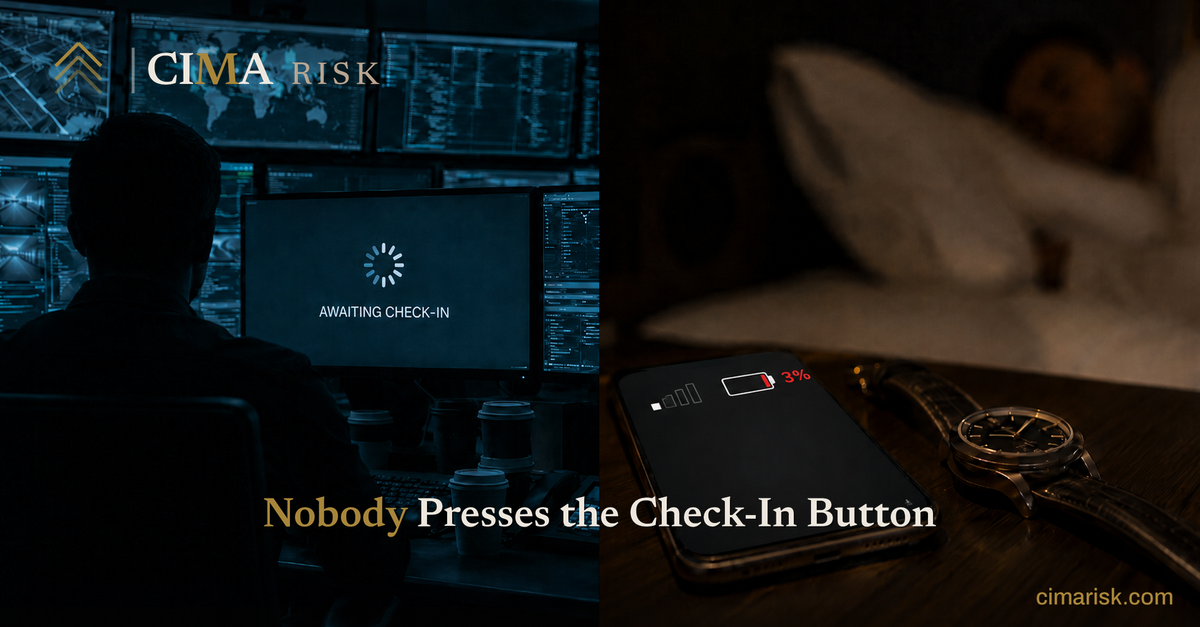
There is a category of travel safety technology built around a simple ask: when you land, open the app and press the button that says you are okay. Press it again at the hotel. Again before dinner. The dashboard back home fills with green checkmarks and everyone sleeps well.
Except nobody presses the button. To understand why, walk through an arrival.
Eleven p.m. at El Dorado
Bogotá's airport runs a late-night rush hour. On the first night of July, more than twenty international flights landed at El Dorado between 8 p.m. and 1:30 a.m.: Washington, New York, Dallas, Madrid, Santiago, Lima, São Paulo, Mexico City, and most of the hemisphere's hubs in between. The evening American from Miami touched down just after 10 that night. A delayed LATAM from the same city touched down two minutes past midnight. Every one of those planeloads makes the same long walk from the gate and hits the same booths at roughly the same time.
The hall sorts you: Colombians and residents one way, foreigners another, crew and diplomats to their own lanes. The veterans move like they live there, because professionally they do. Everyone else drifts with the crowd, reading signs, guessing. Half an hour to forty-five minutes later you clear the booth and get funneled, by design, through duty-free on the way to baggage claim. The bag takes another half hour if the night is kind, which is when you notice your phone has forty notifications and no local network; the international plan that was supposed to activate on landing is still thinking about it. Then one more queue to leave the baggage hall, where your suitcase goes through the customs scanner. Then the doors open onto a lobby full of drivers holding signs and watching faces, and hesitation reads as an invitation.
Ninety minutes to two hours after landing, if nothing went wrong, you are in the car. Thirty to forty-five minutes later, the front desk wants the reservation that is not coming up, then the passport, then the card. In the room, the suit gets hung so it looks presentable tomorrow, because in Colombia the business day starts early: a first meeting at 7 a.m. is normal, and 8 counts as sleeping in.
Nowhere in that sequence does any human being think: let me open the safety app and check in. It will get done in the morning. It will not, and by day three the app has been silenced entirely. The dashboard back home shows an unused app and calls it a safe traveler.
The technology did its job. What failed was the assumption behind it, and the same assumption runs through most of the travel risk industry.
The traveler the industry designs for does not exist
The industry designs for a traveler who reads the pre-trip brief, memorizes the emergency number, checks in on schedule, books through the approved channel, and reviews the country advisory before dinner. The actual traveler just walked out of El Dorado: jet-lagged, focused on the meeting that justifies the trip, treating every safety task as one more piece of admin standing between them and sleep.
The numbers on this come from the industry itself. BCD Travel, one of the largest corporate travel managers in the world, published survey results this spring. About 30 percent of business travelers were unsure whom to contact in an emergency. Nearly a third did not know where to find their company's safety information. More than a quarter said that during an incident they turn to outside sources, meaning the official channel loses to a Google search at the exact moment it was built for.
And nearly one in five hesitate to ask for help at all because they are not sure their situation is serious enough.
These are travelers inside managed corporate programs. The tools exist and the hotlines are staffed, and the travelers still do not use them. Booking tells the same story: SAP Concur's 2023 global survey found 46 percent of business travelers go straight to airline, hotel, or car rental sites to book. Those bookings can sit outside the program's view entirely.
The advice reflex
The industry's response, for years, has been to produce more advice. Share your itinerary. Vary your routes. Check in twice a day. Keep your emergency card in your wallet. We work in this industry and we have written our share of it.
Advice is cheap to produce and it photographs well in a policy document. It also quietly moves the responsibility. If the program's protection depends on fourteen behaviors and the traveler manages nine of them, whatever happens can be framed as the traveler's lapse, which is comfortable for the program and useless for the traveler.
A plan that requires perfect compliance from a tired human is not a plan. It is a hope with formatting.
Design for the traveler you have
The fix is to move the safety burden off the traveler and into the structure of the trip, so that protection is what happens by default when the traveler does nothing extra. Risk gets engineered out, not hoped away.
That looks like specific choices. The safe hotel is the booked hotel, so no decision is required at midnight. The driver is vetted and scheduled before the plane lands, so the traveler never stands in that lobby weighing options. The route between cities is decided by someone whose job is to know what that road is going to look like this week, so the traveler does not have to. Monitoring runs on the itinerary that already exists; visibility never depends on anyone pressing a button. And when something needs to change mid-trip, the call goes from the program to the traveler, with an instruction, rather than the other way around.
The BCD survey points the same direction. The resource travelers say they want most is clear information about the destination before they go, delivered to them without a hunt. Travelers are asking the program to carry more of the load. The industry should take them up on it.
Cars went through the same lesson. Seat belts require the human to act, and for decades most humans did not. Airbags and crumple zones work no matter what the occupant remembers to do. Both matter and both save lives, but each generation of vehicle design has moved more of the protection into the structure itself, so the tired or distracted human is still covered. Engineers stopped betting lives on compliant drivers.
Why Colombia forces the issue
Colombia is where this stops being philosophy. Conditions differ by region and change on short cycles, so the difference between a routine week and a complicated one arrives with little warning. At the end of June, a holiday weekend sent returning traffic down the highway from Bogotá to the eastern plains under a closure plan the authorities had announced days in advance. The corridor held. A traveler flying out that Monday never needed to know any of it, because somebody whose job it is to know had already worked it into the plan for their trip. That is what engineered-out looks like on the ground: quiet. Tracking which week is which is what our weekly Risk Brief exists to do.
A traveler who skips the pre-trip brief in Frankfurt has a boring evening. In Colombia, geography decides exposure, so the program has to do the work.
If a program only functions when people are at their best, it does not function when it matters. Build for the traveler who cleared El Dorado at 1 a.m. By day three of the trip, they are the only kind you have.