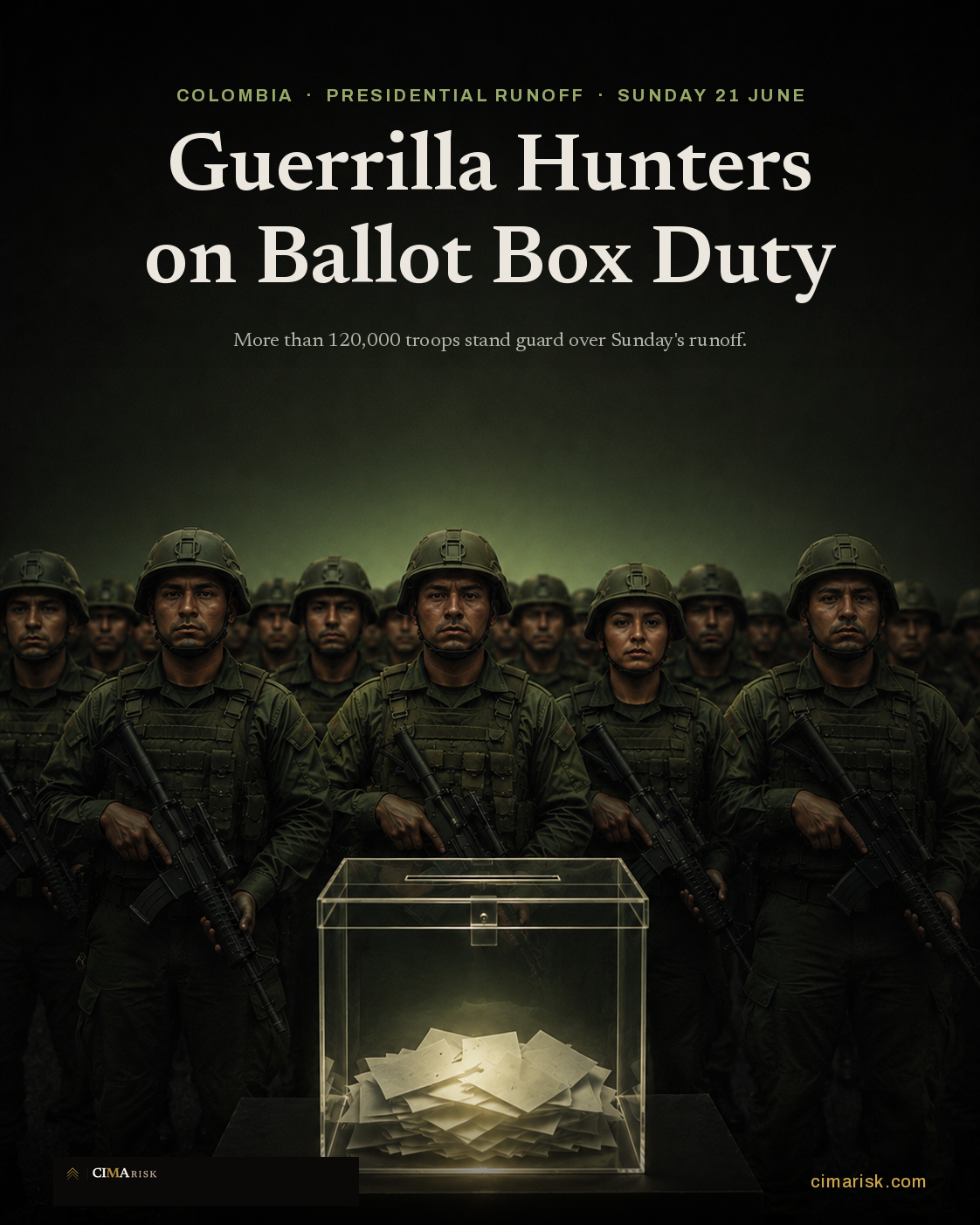
There will be more soldiers and police on Colombia's streets this weekend than at almost any other time of year. The headcount is the easy part. What they are doing is the story: for three days they stop chasing guerrillas and start guarding ballot boxes, and that change moves the risk map more than the result will.
Walk through Bogotá this weekend and you will see the deployment before you hear about it: soldiers at the corners, police at the polling stations, checkpoints that were not there on Wednesday. More than 120,000 troops and police go out for Sunday's runoff, close to the most uniformed presence the country puts on the street all year. The interesting question is not how many. It is what they are doing. For three days the army and the police step back from chasing guerrillas and stand guard over the vote instead. This is our third note on the runoff in two weeks, so we will leave the poll-watching to everyone else. The change in what the forces are doing is the part worth your time, and it has little to do with who wins.
That visible surge points inward, at polling stations and city centers. Behind it, the tempo of the operations that fill an ordinary week drops, the ones that chase the ELN, the FARC dissidents of the Estado Mayor Central, and the Clan del Golfo across the country's hot departments. On June 13 the Defense Ministry put that in writing for one corner of the south, signing a decree that paused offensive operations outright to relocate a frontier unit in Putumayo. Add the closed borders, the suspended gun permits, and the alcohol ban they call Ley Seca, and for about three days the country trades hunting for guarding.
The armed groups watch the calendar too, which is how to make sense of the ELN ceasefire that most coverage filed under good news. The country's largest guerrilla group, which holds much of Catatumbo and Arauca, declared a stand-down for the vote and, to underline it, released two police officers it had held in Arauca for nearly a year. Take the gesture as the calculation it is. The pause covers attacks on the military and nothing else. It costs the ELN nothing operationally, it buys a few days of soft press, and it lands just before a dead-heat election in which the group has an obvious preference, while one campaign is already alleging that armed actors pressured voters across 109 rural municipalities. A ceasefire that returns year-old hostages on a political schedule is positioning, not peace.
Now the call, and the geography is the predictable part. Of course the worst of any week in Colombia lands in the conflict countryside; that holds with or without an election. The claim worth making is about the cities and the clock. We assess that Bogotá and Cali stay calm enough that an ordinary visitor moves around normally. If protests come, they will be small and local, a police line and some chanting near the Plaza de Bolívar or along Séptima, not the kind that shuts down the TransMilenio, blocks the road to El Dorado, or keeps you in your hotel. The unrest everyone is bracing for does not arrive, and the dangerous hours are the ones after the count, Sunday night into Monday, rather than election day itself. The logic is plain. Pressuring a vote is done quietly and early, which is what the coercion complaints across those 109 municipalities describe; open violence waits for the cameras to leave and the troops to drift back to their ordinary work. Watch the places where the armed groups actually hold ground: the Estado Mayor Central's Jaime Martínez and Carlos Patiño fronts across Cauca, the ELN through Catatumbo, and the Clan del Golfo in the Bajo Cauca. If we are wrong, the tell will be a flare-up in Bogotá or Cali on Sunday night that outweighs anything rural by Monday morning. We are not expecting to write that correction.
The coast is the week's quiet alarm
Days before the vote, the US Embassy told its citizens to avoid nine towns in Atlántico, the department wrapped around Barranquilla, places like Soledad and Malambo, over a surge in violence that Los Costeños and Los Pepes, the gangs that run the city's underworld, direct from inside their prison cells. While the cameras point at the capital, a foreign government drew a line around part of the coast, and that problem neither votes nor ends on Sunday. For anyone whose week touches Barranquilla, that notice matters more than the runoff.
Ley Seca, and who actually sets the clock
Ley Seca is the alcohol ban that comes with every Colombian election, and this one runs nationwide from 6:00 p.m. Saturday to noon on Monday. The timing turned into a small circus first: Bogotá's mayor set it for Friday afternoon, then moved it to midnight Saturday, before the national government overrode every city with a single decree at 6:00 p.m. Saturday. If a hotel bar quotes you a different hour, the national decree is the one that holds. Carry permits are suspended for the same window, and the land borders close.
On the football, briefly
It is the other thing everyone is talking about. Colombia beat Uzbekistan and plays DR Congo on Tuesday, and we are not going to turn one match into a World Cup destiny. The only piece that touches your planning is that Tuesday night fills La 70 and the Coliseo Iván de Bedout in Medellín, the public fan zone at Parque El Tunal and the crowds around Parque de la 93 in Bogotá, and Parque de la Retreta in Cali, on top of an already unsettled week.
If your people are on the ground
- Do your moving on Friday or early Saturday. From 6:00 p.m. Saturday until Monday, the alcohol ban (Ley Seca) is on and the land borders are closed.
- Election day, Sunday, is the calm part. The hours to watch are Sunday night and Monday, after the results come in. Keep movement to a minimum then.
- If your route runs through Cauca or Catatumbo, fly instead of drive. Those roads are where the armed groups still hold ground.
- Going to the coast? The US Embassy has warned Americans to stay out of nine towns around Barranquilla after a spike in violence. Check that list before you book anything in Atlántico.
- Colombia plays Tuesday night. Expect big crowds at La 70 in Medellín, Parque de la 93 in Bogotá, and the public fan zones. Steer clear unless a crowd is what you want.
By next weekend, the winner will be old news. What lasts is the trade the country makes to hold the vote: for a few days the army guards ballot boxes instead of chasing armed groups, and those groups know it. That opening, not the result, is what to watch.
CIMA Risk publishes a daily look at Colombia. The full picture, updated as the week moves, at cimarisk.com.